
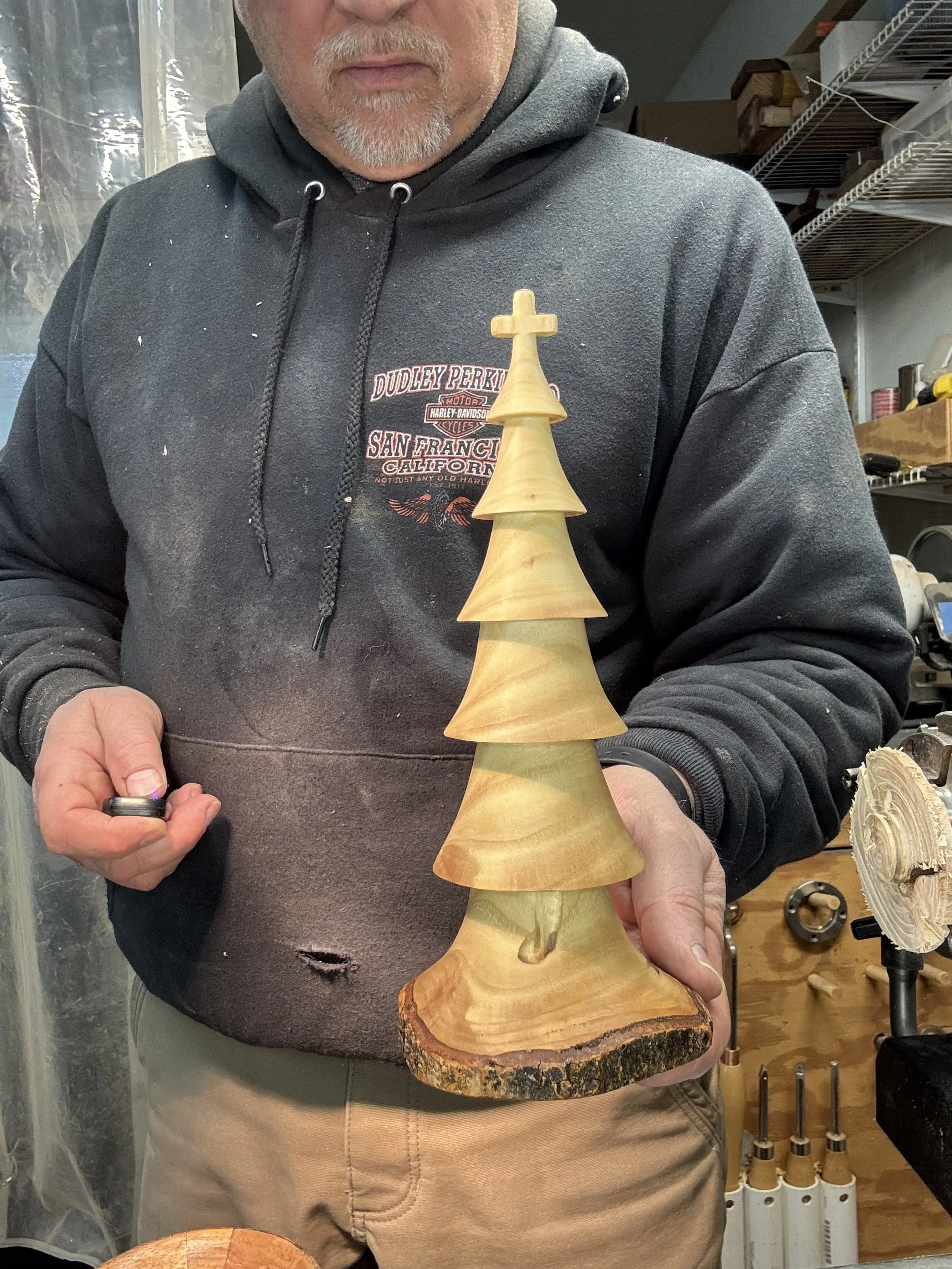
Winter Shop Survival: A Few Lessons Learned the Cold Way
A short, practical reflection on surviving winter in an unheated woodturning shop — with simple strategies for staying motivated, warm, and creatively engaged.
Winter in an unheated shop is a special kind of character builder. It teaches patience, resilience, and exactly how long you can feel your fingers before things get concerning.
Over the years, I’ve picked up a few survival strategies — none of them revolutionary, all of them effective.
First: dress for the shop, not the driveway. Layers matter. Gloves with the fingertips cut off are a rite of passage. If you can still feel the tool and the wood, you’re winning.
Second: shorten your sessions. Winter shop time doesn’t have to be all-or-nothing. Even twenty minutes at the lathe counts. Sometimes that’s enough to make progress — or at least remind yourself why you enjoy turning in the first place.
Third (and maybe most important): lower expectations. Winter isn’t always the season for ambitious projects. It’s the season for practice pieces, experiments, and “let’s see what happens” turning. Not everything has to be gallery-worthy to be worthwhile.
And finally, remember this: if you came back inside with sawdust on your sleeves and a little more warmth in your bones than when you went out, the shop did its job.
Spring will come. Until then, keep the shavings flying — even if you can see your breath while you do it.

How Long Did That Take You to Make?
I don’t track how long it takes to make a segmented vase — mostly because I’d probably quit if I did. A funny take on why the joy of creating beats the clock every time.
There’s one question every woodturner hears sooner or later:
“How long did that take you to make?”
And every time, I have to fight the urge to say, “Define time.”
Because if we’re talking calendar time, it took about a week.
If we’re talking shop time, it took three evenings, two weekends, and several questionable life choices.
And if we’re talking actual hours, well… I honestly have no idea.
Here’s the thing: if I ever sat down and tracked every minute I spent designing, cutting, gluing, sanding, turning, sanding again, finishing, and (did I mention?) sanding — I’d probably get depressed and quit.
🪵 Segmented Turning: The Art of Organized Chaos
A segmented vase or bowl might look elegant when it’s done, but what you don’t see are the hundreds of tiny pieces of wood that had to be cut, aligned, glued, and clamped like a complicated wooden jigsaw puzzle that fights back.
Each segment has to fit perfectly, or else you’ll spend twice as long fixing it. And by the time it’s on the lathe, you’ve invested so many hours that you start referring to it as “the project that will not end.”
❤️ The Real Payoff
So no — I don’t really know how long it takes.
But I do know what happens when someone sees it for the first time.
Their eyes light up, they run their hands along the curve, and they say, “You made this?”
That’s the moment that makes it all worth it — the glue fumes, the sanding dust, the endless patience. Because at the end of the day, I don’t make art for the clock… I make it for that reaction.